

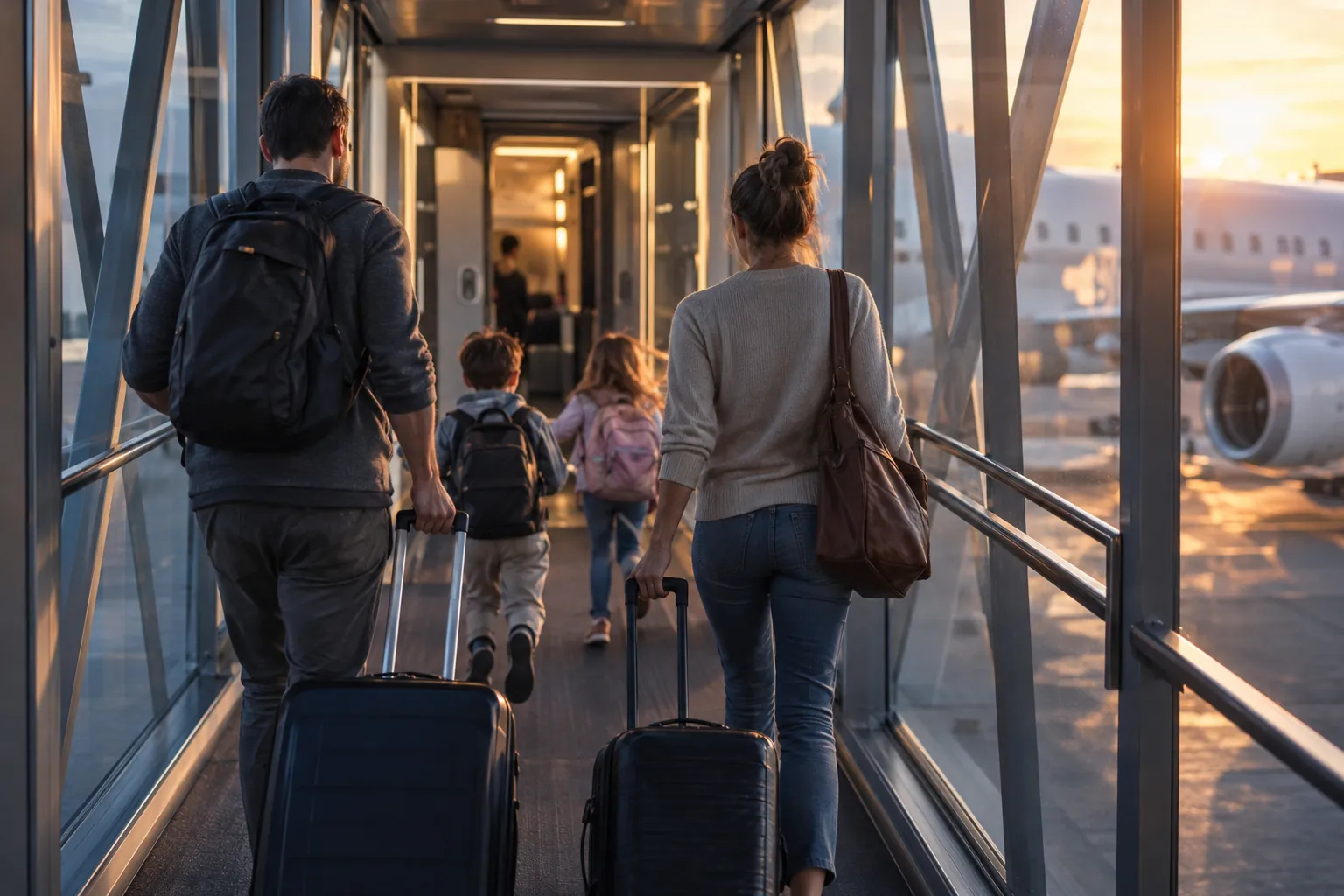
The regional playbooks tell you which carriers and programs are cheap from your city. This one answers the question that decides the method: what does the trip look like? A one-way and a round trip on the same route have different right answers, and so do one seat and four.
Points come first for four of the five trip shapes; two travelers start with a companion deal
The method order for each trip type in this chapter; hover or open Numbers for each step's place in the order
| Trip type | Awards | Mixed cabin | Cash fare | Upgrades | Companion deal |
|---|---|---|---|---|---|
| One-way | |||||
| Last-minuteinside three weeks | |||||
| Peak dates | |||||
| Two travelers | |||||
| Familiesthree or four |
Numbers
| Trip type | Awards | Mixed cabin | Cash fare | Upgrades | Companion deal |
|---|---|---|---|---|---|
| One-way | Try first. 1st: points price every one-way at half a round trip | Later in the order. 2nd: a mixed-cabin round trip | Later in the order. 3rd: a one-way priced from the destination's point of sale | Later in the order. 4th: upgrades | Not in the order |
| Last-minute. inside three weeks | Try first. 1st: last-minute award releases | Not in the order | Not in the order. Cash business inside three weeks is priced for companies | Later in the order. 2nd to 4th: a miles upgrade on premium economy, then a bid, then fixed-price cash upgrades | Not in the order |
| Peak dates | Try first. 1st and 2nd: fixed-price awards at calendar opening, then waitlists | Later in the order. 4th: mixed cabin | Later in the order. 3rd: a sale fare bought in January or September for the following peak | Not in the order | Not in the order |
| Two travelers | Later in the order. 2nd: two awards on a flight showing two or more seats | Not in the order. Not in the order, though the worked example prices it | Later in the order. 3rd: the regional cash plan | Not in the order | Try first. 1st: a companion sale or voucher |
| Families. three or four | Try first. 1st, 2nd and 4th: book at opening on carriers that release in multiples, pool points, split across two programs | Later in the order. 3rd: adults in business on the overnight leg | Later in the order. 5th: cash sale fares in January or September | Not in the order | Not in the order |
DataThis chapter, sections 1 to 5
As ofOct 8, 2026
1. One-way
Method order: points first, then a mixed-cabin round trip, then a one-way priced from the destination’s point of sale, then upgrades.
The numbers. Legacy carriers price a one-way business ticket at 70 to 90 percent of the round trip, worst on Europe to Asia and Australia to Europe. Transatlantic one-ways are now close to half (1,200 to 2,000 USD US to Europe in 2026), and low-cost long-haul always prices per direction. Chinese carriers sit at about 55 to 60 percent (Hainan ex-Cairo 788 EUR one-way against 1,430 EUR round trip); Gulf carriers 65 to 85 percent, with exceptions such as Saudia Singapore to Munich at 773 EUR. Points programs price every one-way at half a round trip, which is the whole case for points.
Worked example. Bangkok to Zurich, November. Cheapest one-way cash about 2,400 USD. Turkish via Istanbul through Aeroplan 92,500 points plus about 120 USD: 2.5 cents per point, or about 1,250 USD plus taxes with points bought at 1.35 cents. If no award exists, build the mixed-cabin round trip (business overnight, economy by day), priced at about half of each cabin’s round trip; see Mixed cabins: pay for lie-flat only where you sleep.
Where it breaks: no award space, which leaves only an upgrade.

2. Last-minute, inside three weeks
Method order: last-minute award releases, then a miles upgrade on a premium economy ticket, then a bid, then fixed-price cash upgrades. Cash business inside three weeks is priced for companies.
The award windows. T-14 to T-7: Emirates business, ANA business and First, Thai (via United), EVA to Star partners around day 7, United and American when upgrades fail to clear. T-5 to T-3, where most close-in drops now land: BA, Gulf carriers on quiet dates, Swiss and Austrian for Miles & More members only. American’s own transatlantic business often appears at 60,000 to 70,000 miles close in, with a free 24-hour hold. See Release patterns and phantom space.
Upgrades, in order of certainty.
| Route | Window | Numbers to expect |
|---|---|---|
| Miles upgrade on a premium economy ticket | Before the airport, when upgrade space exists | BA: 52,800 Avios return New York to London off-peak plus about 792 GBP. Lufthansa: PE to business costs far fewer miles than economy to business. Singapore: Economy Standard only, not Lite. |
| Bid | Invitation 7 to 10 days out, closes 24 to 72 hours before, decision 24 to 50 hours before | Minimums 300 to 550 USD per long-haul segment; Lufthansa winners average 600 to 900 USD on busy transatlantic routes. |
| Fixed-price cash upgrade | Lufthansa app from 360 days to 24 hours out, repriced every few hours; then check-in, lounge, gate | App: PE 150 to 450 USD, business 500 to 2,500 USD, sometimes below the bid minimum. Gate example 150 EUR Frankfurt to Copenhagen. Thai and Turkish standby; Malaysia to three hours before. |
A bid lands business at about half the 2,600 USD fare, if it wins
Frankfurt to New York, one-way, mid-October, booked two weeks out
Numbers
| Option | Parts | Total (USD) |
|---|---|---|
| Business, bought outright | Cash ticket 2,600 | 2,600 |
| Premium economy plus a bid. 300 to 400 USD minimum bid; better odds and a tolerable fallback | Cash ticket 950 + Winning bid 350 | about 1,300 |
| Economy Light plus a bid. A realistic winning bid of about 700 USD; perhaps 50 to 60 percent odds midweek | Cash ticket 480 + Winning bid 700 | roughly 1,180 |
DataThis chapter's worked example; Travel-Dealz, the five upgrade options at Lufthansa
As ofOct 8, 2026
Worked example. Frankfurt to New York one-way, mid-October, two weeks out. Economy Light 480 USD, premium economy 950 USD, business 2,600 USD. Economy plus a realistic winning bid of about 700 USD is roughly 1,180 USD at perhaps 50 to 60 percent odds midweek. Premium economy plus a PE-to-business bid at a 300 to 400 USD minimum is about 1,300 USD with better odds and a tolerable fallback. Premium economy plus 25,000 to 35,000 Miles & More miles confirms instantly if upgrade space exists. The Upgrade bid tool runs this; airline tables are in Upgrade bidding: the airlines, the windows, the math and Miles upgrades and cash upgrade offers.
Where it breaks: a full cabin. Try to book nine business seats on the airline site first; nine available means minimum bids clear, one or two means skip.
3. Peak dates
Method order: fixed-price awards booked at calendar opening, then waitlists, then a sale fare bought in January or September for the following peak, then mixed cabin.
Why points win here. Cash business over Christmas, Easter, summer and Lunar New Year surges; a fixed-chart award does not. Qatar’s Saver moves from 42,500 to 55,000 Avios Europe to Doha on peak dates, Iberia from 40,500 to around 50,000, a fraction of the cash movement. Dynamic programs (Delta, United and Air Canada own-metal, Qantas Classic Plus) surge with cash; book partners on fixed charts.
Book the morning the calendar opens. Singapore 355 days at 8 am Singapore time; ANA 355; JAL and Cathay 360; Qatar 361; Virgin Atlantic 331 with at least 2 Upper Class seats guaranteed per flight. ANA releases one or two business and one First seat per flight at opening, so set the alert for that morning.
Waitlists are the second chance. KrisFlyer Saver and Advantage can be waitlisted to 21 days out and clear by status around day 14. Waitlist several flights; you need miles only for the most expensive, and hold a confirmed backup elsewhere.
Worked example. Two seats Europe to Bangkok via Doha over Christmas. Peak Qsuite Saver 55,000 Avios Europe to Doha plus Doha to Bangkok: budget 85,000 to 102,500 per person. Book at 361 days on qatarairways.com, then alert for better. If Saver seats never appear, the January sale for the following December is the fallback. Where it breaks: waiting. Peak seats on popular routes go within days.
4. Two travelers
Method order: a companion sale or voucher, then two awards on a flight showing two or more seats, then the regional cash plan.
Companion sales and vouchers. Lufthansa ran a 50 percent companion special in September 2026; China Southern’s FLYCOMFORT ran to January 2026; Qantas and Cathay run companion sales in Australia. In the UK, the BA Amex Premium Plus voucher (after 15,000 GBP of spend) brings two Club Suite seats to New York to around 100,000 Avios plus about 700 GBP in fees.
The two-seats rule. Shortlist only flights showing two or more seats, and transfer points only after the itinerary reaches the payment page for two. Virgin Atlantic guarantees at least 2 Upper Class seats per flight at opening, the most dependable program for a pair far ahead.
Worked example. London to Bangkok for two, outbound overnight. Full Qatar business round trip about 3,400 GBP each at normal pricing; mixed cabin (business out, economy back) about 2,250 GBP each, saving 2,300 GBP for two. Or a Qsuite one-way award via Avios for both, two seats confirmed first, plus a cheap economy return. Where it breaks: bids. Many systems treat the booking as one bid for all passengers (Malaysia, Cathay), so with one seat left a pair loses to a solo.
5. Families of three or four
Why awards get hard. Most airlines release one or two premium seats per flight (ANA one to two business and one First). Four fixed-chart seats on one flight is rare; dynamic programs sell four at prices that track cash.
Method order:
- Book at calendar opening on carriers that release in multiples: Turkish (mass releases for Istanbul routes October 2026 to February 2027), Starlux via Alaska (up to 4 business seats per flight for travel to June 2027), Virgin Atlantic (2 guaranteed).
- Pool points. Avios Household Account (7 members, same address) plus free “Combine my Avios” across BA, Qatar, Iberia, Finnair and Aer Lingus; Qatar’s family program (10); Etihad and Emirates (8 to 9); Flying Blue Family (8, 25 percent off child awards); Velocity (6). Aeroplan Family Sharing has been disabled since August 2023 and its return is unconfirmed.
- Mix the cabins. Adults in business on the overnight leg, everyone in premium economy by day; or two awards plus two cash premium economy seats on one flight.
- Split across two programs with cheap cancellation (American and Alaska free, Qatar 25 USD, Iberia up to 25 EUR), then consolidate.
- Cash sale fares in the January or September window are often the honest answer for four: an 1,800 EUR ex-Rome Qatar fare times four beats four awards on friction.
Worked example. Family of four, US West Coast to Southeast Asia, summer. Starlux via Alaska: 4 × about 75,000 points, Los Angeles to Taipei with a free stopover and the onward Southeast Asia leg included, about 70 USD taxes and a 20 USD partner fee each. Alaska redeposits free apart from the fee, so book the moment four seats show. If only two show, book them plus two Aeroplan seats on EVA or ANA (Vancouver or Seattle at 55,000 each) and cancel the spare pair inside its free window.
Families transfer points for four on the strength of a cached search, then find two seats at the payment page. Verify live for the full party, hold where you can, then move points. The 20-minute award search has the sequence.
What to do if it fails, for every trip type
- Widen dates three days each side and add nearby airports; Tuesday, Wednesday and Saturday departures show the most award space.
- Swap alliance order, then the non-aligned carriers (Emirates, Etihad, Virgin Atlantic, Starlux).
- Book a fallback in a free-cancellation program and keep the alerts running.
- Run the Plan my trip tool again with honest inputs. If it points to a cash fare at the regional target, buy it and credit the miles.
The tools (Points vs cash, Buy-points evaluator, Upgrade bid, Sweet spot finder, What’s a good price?) hold the current numbers; this chapter holds the order.
Sources checked
- AwardWallet, award ticket change and cancellation policies, updated 4 Oct 2026
- Premium-Flights, SAS Bangkok to Europe one-way, 6 Oct 2026
- Simple Flying, airlines where premium economy is the smarter buy, 20 Aug 2026
- AwardFares, guide to award release dates, updated 7 Jul 2026
- Travel-Dealz, the five upgrade options at Lufthansa
- The Points Guy, airlines that allow family pooling