

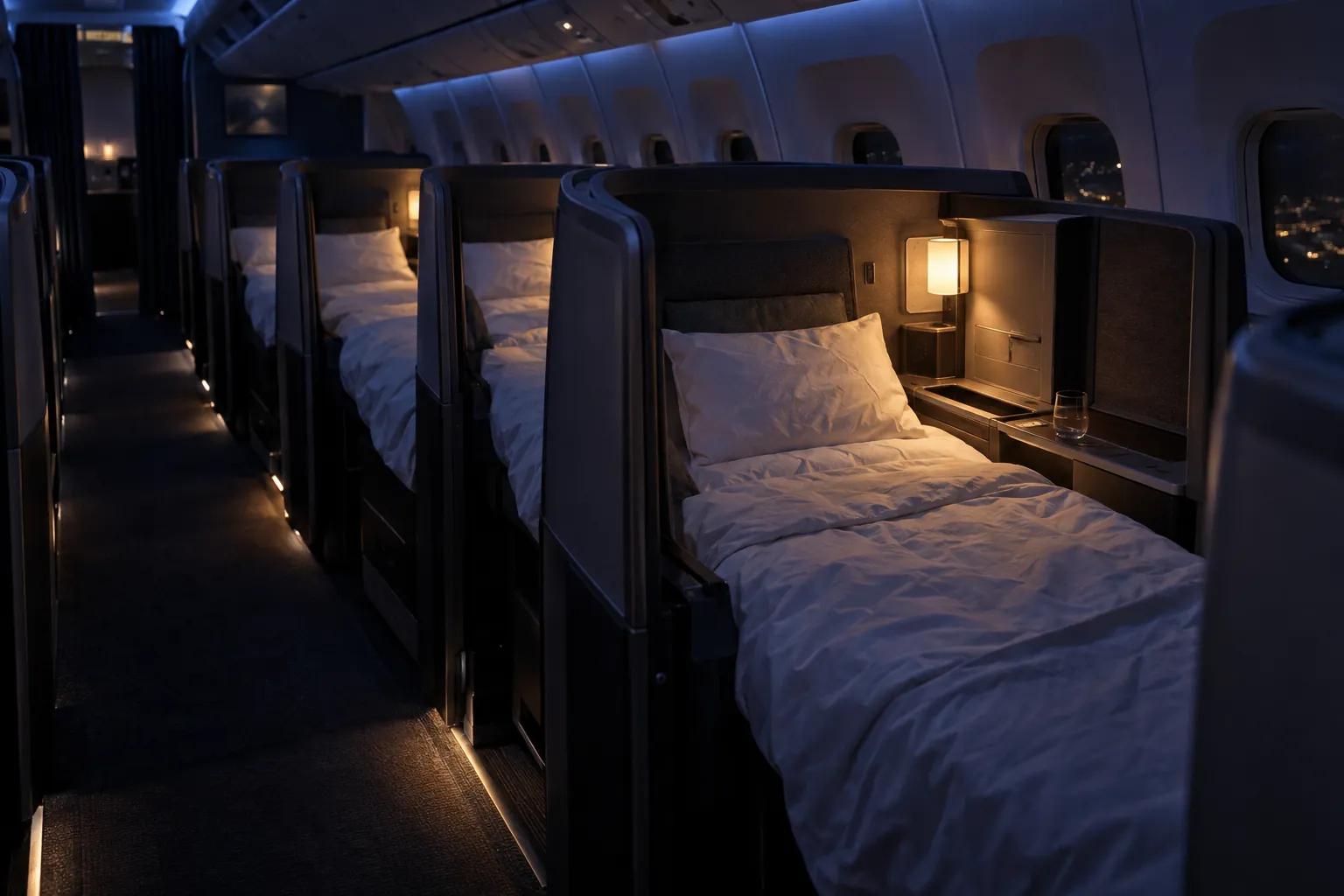
Every business class seat is sold at several prices at once. The person next to you may have paid four times what you did, or a quarter. Nothing about the seat changed. What changed is the route the money took to get to the airline.
This chapter gives you the price map. Everything else in the guide is a way of moving from an expensive point on it to a cheap one.
The four price points
1. The published fare. What you see when you search a specific date, a specific route, with the airline’s own flight numbers. Long-haul business from Western Europe or North America typically shows at 3,500 to 7,000 US dollars round trip. This is the number airlines quote when they say “a 6,000 dollar seat”, and the number course sellers use when they claim 80 percent savings.
2. The sale fare. The same seat, same airline, bought in a promotion or from a cheaper origin. Qatar, Emirates, Etihad, Turkish, the Lufthansa group and the Chinese carriers all run business class sales several times a year. Europe to Asia drops to 1,600 to 2,400 euros round trip. The US to Europe drops to 2,000 to 2,800 dollars. These fares are public. Nobody needs a course to buy one; they need to know when and where to look.
3. The award. The seat bought with points. Business one-way Europe to Asia runs 60,000 to 120,000 points plus 50 to 500 dollars in taxes depending on the program. If you earned those points from a credit card bonus, the seat cost you an annual fee and some discipline. If you bought them in a sale at 1.3 to 1.6 cents each, the seat cost 900 to 1,600 dollars one-way, plus taxes.
4. The upgrade. Economy or premium economy fare plus a bid, a miles upgrade or a cash offer at check-in. Long-haul upgrades clear anywhere from 300 to 1,500 dollars per segment. Added to a 700 dollar economy fare, a lie-flat seat for 1,200 to 2,000 dollars round trip is realistic on the right flights.
Savings claims always depend on which price you compare against. Against the published fare, a 1,900 euro sale fare is “70 percent off”. Against the sale fare, the same points booking saves 20 percent or loses money. Throughout this guide the comparison is always to the cheapest cash fare you could actually buy for that trip, because that is the money you would otherwise spend.

Why the same seat has four prices
Airlines price to fill the cabin with the maximum revenue, not to be fair. The tools they use create the gaps you can exploit.
Fare buckets. Each cabin is split into booking classes (business might be J, C, D, Z, P, I). Each has its own price and its own quota of seats. When the cheap buckets sell out, the price jumps even though the cabin is half empty. Buckets reopen when bookings cancel or when revenue management decides the flight is behind forecast. This is why fares move daily and why “the price went up overnight” is normal.
Point of sale. The same flight is priced differently depending on where the trip starts and sometimes where it is bought. Competition in Cairo, Colombo, Oslo or Jakarta is fiercer than in Frankfurt or New York, so fares starting there are lower, even for the identical long-haul legs. Chapter Origin arbitrage is built on this.
Round trips versus one-ways. From Europe and North America, a one-way business fare is often 70 to 100 percent of the round-trip price. Airlines do this on purpose: business travelers who need one-ways will pay. Points programs mostly price one-ways at half a round trip, which is the single biggest reason points beat cash on one-way trips and lose on round trips.
Distressed inventory. Two weeks before departure, airlines know roughly how many business seats will go unsold. They release some to award bookings, offer upgrades to economy passengers, and auction the rest. The seat is worth nothing to them once the door closes.
Partnerships. When you book Thai Airways with United miles, United pays Thai a negotiated rate per seat, often far below the retail fare. Your miles buy the seat at that wholesale price. The trick is that different partners charge you wildly different amounts for the same Thai seat, and airlines can shut the door: Lufthansa Group stopped releasing its cheapest business and all First Class seats to partners in June 2026.
A worked example: Bangkok to Zurich, November
A real search in October 2026 for a round trip in November showed:
The cash fare wins the round trip; points win the one-way
Bangkok to Zurich, November 2026, one traveler. Searched in October 2026.
Numbers
| Option | Kind | All-in (USD) |
|---|---|---|
| Swiss nonstop, published fare. What most people think business costs | Published fare | 4,900 |
| Etihad via Abu Dhabi, cash. Found on Google Flights in minutes | Sale or cheap cash fare | 2,050 |
| Aeroplan award, round trip, 2 x 92,500 points bought at 1.35 cents. Loses to cash on the round trip | Award with points | 2,500 + taxes |
| Aeroplan award, one-way only, 92,500 points. Beats any one-way cash fare on the route | Award with points | 1,250 + taxes |
| Etihad economy plus a bid on the overnight leg. Only if the bid wins | Upgrade | 1,400 to 1,700 |
DataGoogle Flights, swiss.com, aeroplan.com
As ofOct 8, 2026
Compared with the Swiss published fare, the Etihad cash fare is 58 percent off. Compared with the Etihad fare, buying points for the round trip is a loss. For a one-way, points win clearly. Same traveler, same month, three different right answers depending on the shape of the trip.
What a good price looks like
You cannot judge a fare without a reference. These are round-trip business fare ranges that count as “good” in 2026, meaning you should book rather than wait. They move with fuel prices and season; the What’s a good price? tool keeps the current ranges.
| Route pair | Good round-trip fare | Typical sale carriers |
|---|---|---|
| Western Europe to Southeast Asia | 1,600 to 2,000 EUR | Qatar, Etihad, Turkish, Chinese carriers, Oman Air |
| Western Europe to US East Coast | 1,100 to 1,750 EUR | TAP, Aer Lingus, Icelandair, Air France/KLM sales, Finnair |
| US to Western Europe | 1,700 to 2,400 USD | Same carriers from the other end, plus Lufthansa group sales |
| US West Coast to East Asia | 2,500 to 3,500 USD | ANA, JAL, Starlux, Korean, Chinese carriers |
| Southeast Asia to Western Europe | 1,900 to 2,600 USD | Etihad, Qatar, Turkish, Chinese carriers |
| Australia to Western Europe | 4,000 to 5,500 AUD | Qatar, Etihad, Vietnam Airlines, China Southern |
| Middle East to Europe | 1,100 to 1,700 USD | Royal Jordanian, Pegasus-connected, Gulf carriers |
If you see a fare at or below these, it is a sale fare and points will rarely beat it on a round trip. Here is where that band sits for the first route against the normal and published fares:
Western Europe to Southeast Asia: book at or below 2,000 EUR, against 4,500 published
Business round trip, one traveler, EUR
Numbers
| Row | Range |
|---|---|
| Sale fare: book at or below. Qatar, Etihad, Oman Air, Gulf Air, Turkish, Chinese carriers | 1,600 to 2,000 EUR |
| Normal fare | 2,200 to 3,200 EUR |
| Published fare | 4,500 EUR |
DataRoute fare ranges observed in 2026; Turning Left For Less, Oct 2026
As ofOct 8, 2026
Where this leaves you
Four prices, one seat. The rest of this guide covers how to reach each of the cheap ones:
- Cash fares chapters: how to get price point 2 reliably, and sometimes lower through sales, origin arbitrage, mixed cabins and error fares.
- Points chapters: how to reach price point 3 whether you have credit cards or not, and which redemptions are worth it.
- Finding seats: the part most people fail at. Award seats exist; knowing when airlines release them is the skill.
- Upgrades and status: price point 4, with the odds spelled out.
- Booking mechanics: the rules that stop a cheap ticket becoming an expensive mistake.
Read the next chapter for the five methods compared side by side, then use the Plan my trip tool before every trip.